Friday, 24 June 2016

PFO & DIVING.


This is a story very close to me that up to a year ago i was not 100% sure how bad a PFO is till one day my girl friend and me went to Gozo for day deep diving, following all the rules and doing nice profile dives between 30-40 meters only to find on our way back her skin started to break out in a rash,then migraines,to the point 2 hours later as we arrived back in Malta to rush straight to the chamber were she was decompressed for 12 hours, below is an article about what is and how serious it is for diving


A hole in your heart would seem to be the very definition of a “problem.” Yet more than a quarter of the population has one, and for most it causes no adverse health effects. In fact, the vast majority of those affected don’t even know it. There are two kinds of holes in the heart. One is called an atrial septal defect (ASD), and the other is a patent foramen ovale (PFO). Although both are holes in the wall of tissue (septum) between the left and right upper chambers of the heart (atria), their causes are quite different. An ASD is a failure of the septal tissue to form between the atria, and as such it is considered a congenital heart defect, something that you are born with. Generally an ASD hole is larger than that of a PFO. The larger the hole, the more likely there are to be symptoms.
PFOs, on the other hand, can only occur after birth when the foramen ovale fails to close. The foramen ovale is a hole in the wall between the left and right atria of every human fetus. This hole allows blood to bypass the fetal lungs, which cannot work until they are exposed to air. When a newborn enters the world and takes its first breath, the foramen ovale closes, and within a few months it has sealed completely in about 75 percent of us. When it remains open, it is called a patent foramen ovale, patent meaning open. For the vast majority of the millions of people with a PFO, it is not a problem, even though blood is leaking from the right atrium to the left. Problems can arise when that blood contains a blood clot.
This incomplete seal is what is termed patent foramen ovale, although it remains closed because of the pressure differential between the two atria. (Patent is Latin for open, indicating the incompleteness of the seal.) In rare instances, the foramen ovale remains completely open - this condition is more pronounced and is called atrial septal defect. Why should the presence of patent foramen ovale be important? It isn't to a nondiver. People with patent foramen ovale are completely unaware of it and will go through life completely free of any symptoms related to it. For a diver, it is important. The reason is that some divers, depending on depth and duration of their dives, produce bubbles in their venous blood during and after decompression (ascent from the dive). These bubbles are small, usually relatively few in number, and do not give rise to any symptoms since they are trapped by the small blood vessels in the lungs and filtered out of the circulation.


Recent evidence shows that after decompression, many normal scuba dives, with no symptoms of decompression sickness, may produce bubbles in the venous blood. Why is this important for a diver with patent foramen ovale? It has been found that some people with patent foramen ovale may actually pump leak quantities of blood from the right atrium to the left atrium. This suggests that divers who have patent foramen ovale who also have venous gas bubbles during decompression may pass gas bubbles directly into the left atrium, bypassing the lungs. Gas bubbles in the left atrium are then carried to the body tissues, where they cause symptoms which all different from migraine’s,loss of sight, fatigue, dizziness ect .


Can it be fixed? Yes can all PFO be repaired? No.
A catheter can also be used to guide the placement of a patent foramen ovale closure device - which becomes a permanent implant - that will close the hole (prevent the flaps from opening) in the heart wall. The catheter is initially inserted into a large vein through a small incision made usually in the inner thigh (groin area). The catheter is slowly moved into the heart and the PFO closure device is moved through the catheter to the heart and specifically to the location of the heart wall defect.  Once in the correct location, the PFO closure device is allowed to expand its shape to straddle each side of the hole. The device will remain in the heart permanently to stop the abnormal flow of blood between the two atria chambers of the heart. The catheter is then removed and the procedure is complete. The cardiac catheterization procedure for a PFO closure typically takes 2 to 4 hours to complete. A local anesthetic is used to numb the groin area where the catheter was inserted. Use of general anesthesia or sedation by IV is situation dependent — depending on doctor preference and particular patient needs.
Depending on the size of the PFO and location if it can be fixed as not all are repairable.
She has had her PFO closed and has done a number of medical test to make sure its safe for her to start diving and has been given the ok to start diving, but how will this effect her, well now she has to start from shallow dives max 4-5 meters and on high oxygen blends or commonly known as Nitrox to divers, and long safety stops running on Air tables for extra safety margins.

Wednesday, 8 June 2016

What to do on your day off!


What do you do on your day off? Well as instructor? Me well i decided i wanted to go for dive with my side mount gear and just relax and practice my shut down skills and have relaxed dive down to the P29.
Getting down to the stern of the wreck and seeing i am the only one here i got that feeling of peace and  at one with nature watching all the sae bream swimming past and the barracuda.
Dropping down into the wreck and seeing all the germany written still on the fuses and control panels all over the ship, and looking at the narrow passage ways how sailors use to run the corridors,
With the bow on the sand at 38 meters and the stern 32 its a great dive with great advantages for courses ranging from deep & wreck to tec training,
With the top of the mast being 18 meters she is a fantastic dive and one of my fav wreck dives in the 30-40 meter range.
For more information on the P29 click on the link bellow.
p29-patrol-boat-malta-39-meters


Wednesday, 1 June 2016

Summer has started.


So the summer has just started and bookings are flying in!
So we started over the weekend over at Buddies Dive Cove Malta, were we started running PADI TecRec 40, on Friday morning with the orientation and introduction to tec and the kit that will be used,


 Once we got all the kits set up and everyone was relaxed, we then headed back to the classroom,
  • Technical diving’s risks and responsibilities
  • Technical diving equipment, proper rigging and set up
  • Gas planning, oxygen limits and decompression planning
  • Team diving techniques and emergency procedures, such as dealing with free flows, manifold leaks and out of gas situations
So now we covered all the Theory and watched the skill circuit and knolage reviews its off to the water for skills and a dive to see how the guys get on and were we need to adjust kit and view weak points, if any,as it was everything was great,first 5 min in the waster just slight adjustments and away we went, skills were great, till it was time to exit the water! that's when it hit them on how heavy the kit was when getting out!

But as the next few days went they found it easier and more relaxed, to the point that we thought they made a mistake on the sac rates, but they were correct. Then sunday came and it was the last day final exam and final dive, as for the exams flawless 97% on the exam, so now we are ready for the final dive and off we went to the Rozi and it was fantastic everything came togheter on the last dive now they looked like tec divers in the water, So big well done to Gordon & Frank on passing the tecrec 40 and will see you soon for side mount and tec 45 training later in the year.
Then monday rolls round the corner and its off to SEA-SHELL Dive School, where we were booked for the Padi Side Mount course, so they come in to class at 08.15 which is good 10 min early.. so we chat about why they want to do SM diving, so they explains that there air consumption was high and wanted to see if it would be better for them in SM, so we start setting up cylinders and regulators for the first dive,as they said wow thats different and not as heavy as they thought!
Because you put your tanks(cylinders) on in the water......
So the 1st dive was fun with some small problems as you do in any course but we survied and headed back to the classroom and done more theory and practice on land and cylinder set up between steel and aluminum... and thats when it all started to make sense and sink in!
So on Tuesday morning we set off for our final 2 dives of the course and again cylinder set up and briefing over the skills, and we went and it fell into place out of air sharing, broken bunge, broken cylinder clip, flutter,,,, they are ready for the final dive, so we went for our last dive which was 72 min and the final senario went so well i was impressed with not only my teaching but how my students have followed step by step.

So if you want training with-out short cuts then be sure who and were you are training as it all about 100% dedication to diver training and education, we do not agree with cutting corners or safety.


So if you are interested in doing some diver training contact us to see what courses we are running and depending were you are staying in Malta so we can use one of our partner school's (close to you) around the island to save on traveling time.


Tuesday, 24 May 2016

Memory's of how & why i became a diver!


Blue Hole Gozo.


Memory’s from when I was young boy till today and how diving became my life..
I all ways remember sitting at my grans house in summer in marsascala Malta at young age watching my uncle prepare for diving, and watching him go down and return hour later with amazing stories of big fish and photos to prove it! So as I grew older I found my nose stuck in books about diving reading Padi Open Water book when I was 9 years old, I suffered from dyslexia a lot of what I read didn’t stay in nor did I understand it, but I was always keen to learn and I have always been a good swimmer.


10 yrs old i Zabbar Malta.
In my teens I swam for my school and then found myself running for long time for schools and clubs and then the ARMY came along,17 years old and I changed for better or worse! 19 and I am out and working in Security were I then headed to Malta. I loved it even more now the sea at the bottom of the road the local church community, and helped out there on Sundays giving my experience as runner and swimmer , and I met people from the area some I knew from my childhood, till one day I waked into I dive shop in poala, DIVE MED Malta, and I bought my first mask snorkel and fins that I still have today and started Free Diving, at first 2 meters 4 meters till one days I was down on the wreck swimming along the wreck of tug  St Michael in marsascala(21 meters)….

End of my 1st wkend home.
I was ready for the next step so i walked into Dive Med and the owner Manuel who has become a dear friend who has taught me so much over the years is the guy I hold responsible for what I have become today! That was back in April 2002 and I haven’t looked back, I took it in my stride with work I got transferred to Italy that didn’t stop me I started diving again in Genova were I meet amazing people and done my Deep Spec on the MV Haven the bridge of the super tanker is at 34/5 meters the propeller is at 90 meters to give u the size of this ship! Then I wanted to go deeper!
3 weeks later my dreams are shattered I am on my way back to Uk I start diving in my home town Brighton Uk, get myself some more speciality’s and moved up to rescue in 2004, and got some fantastic dives in on the English Channel on the war wreck heading out to France in the fog in the middle of the night for surprise attacks, tanks & jeeps lay across the sea bed in some areas and then blank nothing for ages swimming around then you find the wreck mass built Liberty ships and barges but the vis wasn’t as good as Italy or Malta, but then once again I get call from the office and I am being transferred to Malta for 6 weeks… well my bags were packed dive gear security pass and suit 1 pair of shoes and 5 shorts  and I was gone!


Marine Security.
Malta 2005 I met up with family and friends and worked and dived that was it for me for 6 weeks, then I left my job and started working and living in Malta full time till I done my Dive Master in 2007 and that’s when I knew I wanted to teach! So then my Technical training started in early Feb 2008 followed by my IDC (Instructor Development Course) in March, know I think I was in Hot water if I remember correctly, but with an CD like we had at Dive Wise (Allan Whitehead) I spotted our weak points and drummed into our skulls what was what and then came the IE(Instructor Exam) 3 days of intense exam and teaching in front of the top Examiners in the Padi industry, was I nervous was I scared well if I say no I am lying was so scared I needed 10 coffees before I left my house that morning….. And for what I passed with average of 93%...... time to celebrate.  As time got on dive built up my mum died of brain cancer so I decided to do something about it and put in a bid to raise money for cancer research but how was I going to do this?

Day before IDC

Malta 2009 my event was to Break the Guinness World Record for the longest dive for Cancer Research, the record was 24 hours so week after week seen the dives getting longer and longer, till on day in September I dropped my head under the water and stayed down and didn’t come up till the record was broken 25 hours 10 min later I left the bottom with 2 hours of deco ahead… but I broke the record and done a bit of fund raising were we raised 900 pounds not a lot but it helps….
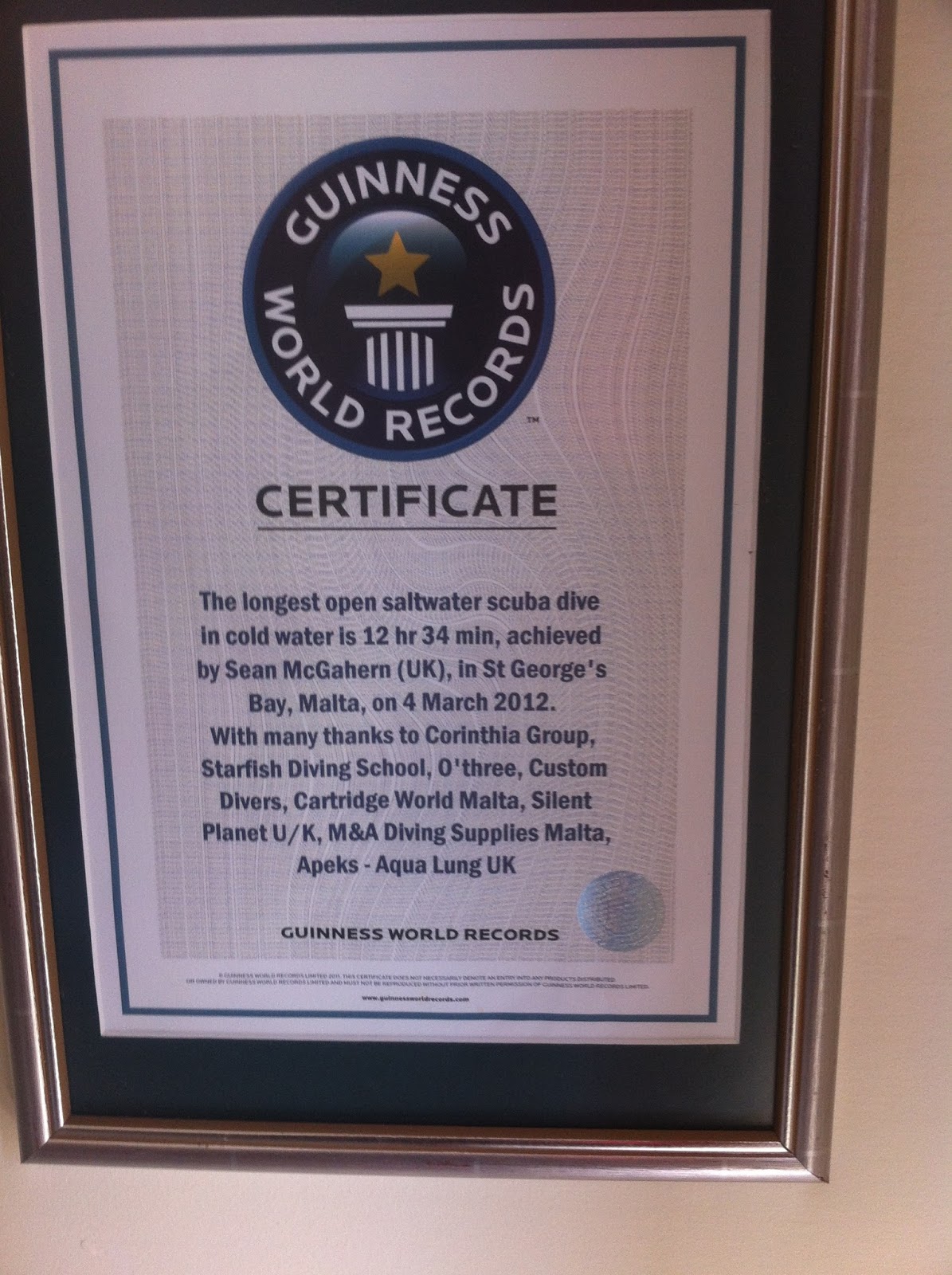
Over the next couple of years, I found myself in and out of teaching as security work was always in the back ground… so realised I wasn’t my happiest so I got back in the water again for charity and broke the longest cold water dive of 11hours 41min to 12 hours 34 min in 2012 and then again in 2013 for the warm water record and moved it to 50 hours…. I found myself in the water if not training teaching or just diving so I decided that it I gave up everything and devoted my time and energy into diving, but why its not the best paid job!  But it’s the memories of seeing people breath under water for the first time and they look at you with surprise and happiness and that becomes over whelming some times for them, taking people on wreck for the first time and hearing them under water…….

Cold water record
Longest warm water record.

Even today I am MSDT Tec Blending instructor and tec instructor and even recently I done group dive on ocean liner and to hear tec diver shouting at 60 meters ‘wow look how big the ship is’ with slight tone in the voice like the chip monks due to the depth and helium TMX we use, at that depth air is not good for divers but we save that for different story! Today I work freely between a number of school teaching any course from open water to technical, and a lot of school give me a call from time to time to book me for priv guiding or courses or vice versa I have big groups that book to come over and we all help out! And even though I have now been diving 14 years with around 5,000+ dives between 10 meters and 100 meters I still love doing Discover Scuba Diving programs the first breath under water…. The look of them before and after……
Then late 2015 i done a shark tank dive for 5 days to raise awarness of our Oceans and to educate people that we can live and swim in the ocean with sharks with out shark suit, eat and slept in the tank, raising money for Project Aware Sharks in peril, where we were joined by Shark Lab Malta that help release sharks back in to the see through conservation programs.


5 day shark tank dive.

Seasson 2016 is just under way if your coming out be sure to BOOK!

Add caption